

In most Indian schools, teachers manage big classes, strict periods, and heavy syllabi. So when people talk about experiential learning, it can sound like something meant only for fancy schools. But that is not how it works in real life. Easy experiential learning for teachers does not need smart labs, field trips, or extra budgets. It only needs a shift in how a lesson is handled.
Students learn best when they use what they study. Not when they only copy it. Hands-on learning, student reflection, and real-world application can all happen inside the same classroom you already teach in.
What is experiential learning?
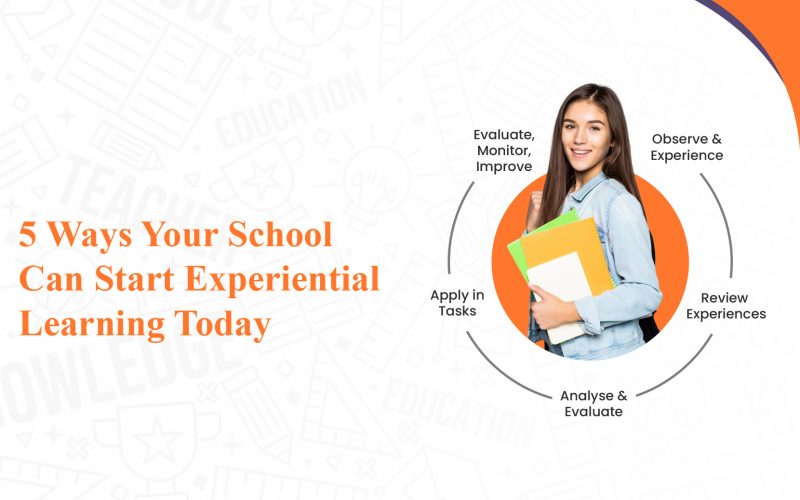
Experiential learning is activity based learning where the students learn by doing instead of being passive listeners. They take part in an activity, think about what happened, connect it with their real world. This process helps students build critical thinking, problem-solving, and other 21st century skills. In simple terms, it is learning through experience, followed by reflection.
Why experiential learning actually fits Indian classrooms
Our system is still exam-driven. Students memorise fast. But exams today also test thinking, not just memory. That is where experiential learning helps. First, students do something. Then, they think about it, connect it to theory and finally try again.
This builds critical thinking, problem-solving, and real practical skills. And yes, even in a class of 45 students, easy experiential learning for teachersis possible if the activity is short and focused.
1. Use the fishbowl for discussion and reflection
The fishbowl is an easy way to turn a normal discussion into active learning. A few students sit in the middle and talk about a topic. The rest of the class listens. They do not interrupt. After that, the outer group shares what they noticed. Who spoke clearly. Who explained well. What arguments made sense. This works well with:
- History debates
- English literature
- Social issues
- Case studies
It costs nothing. It needs no prep once students understand the format. And it quietly builds listening and speaking skills. For many teachers, this is the first step into easy experiential learning for teachers without changing the lesson plan.
2. Short role play and classroom simulations
You do not need a full project for this. Even a 10–15 minute classroom simulation is enough. Some classroom examples include:
- In civics, students act as panchayat members solving a water issue
- In maths, they plan the budget for a school trip
- In economics, they run a small market inside the classroom
Students apply what they learned instead of only writing about it. That is real-world application in a simple form. This also pushes active learning instead of passive note-taking.
3. The 3-2-1 reflection at the end of the lesson
Many teachers do activities. Very few close the loop. Reflection is where learning settles. The 3-2-1 reflection is simple:
- 3 things I learned
- 2 ways I can use it
- 1 question I still have
Students can write this in their notebooks. No printing. No checking load every day. This is one of the easiest ways to add student reflection after a lesson. It also gives teachers direct feedback on what students did not understand. This is a key habit in easy experiential learning.
4. Low-cost maker challenges with waste material
You do not need expensive kits for project-based learning (PBL). Indian schools already reuse a lot of material. Try challenges like building the tallest paper tower, making a bridge from an ice-cream stick, and protecting an egg using only newspaper
Here, the output is not the main thing. The thinking is. Students test ideas, fail, fix, and try again. That is real problem-solving. It also builds teamwork and basic design sense. These maker challenges are some of the best low-prep experiential learning ideas for high school and even middle school.
5. Peer tutoring
Peer tutoring works quietly but strongly in Indian classrooms. Some simple ways include good English speakers helping weak readers, students good at maths can help their peers.
When students teach, they understand the topic better. When they learn from seniors, they feel less pressure. This builds confidence on both sides. It also answers a common question teachers ask: How to integrate hands-on learning into the existing curriculum without adding new periods. This method fits naturally into easy experiential learning for teachers.
Two common doubts teachers have
- What is the biggest mistake in hands-on learning?
- Doing the activity but skipping reflection. Without reflection, students stay busy but not thoughtful.
- How can this fit into the CBSE or ICSE syllabus?
- Do not add new work. Replace one worksheet. Replace one written test. Replace one homework. The time stays the same. Only the method changes.
Experiential learning is not a special program. It is not something that needs approval, training, or money first. It starts the day a teacher decides to let students apply, not just write. Easy experiential learning for teachers is not loud. It is quiet. It grows slowly through daily classroom habits. And it works in government schools, private schools, small towns, and big cities alike.
Experiential learning is an important aspect of AASOKA’s way of teaching-learning. The textbooks contain multiple activities and project-based learning tasks that help students connect with the world around them and develop skills like logical thinking, collaboration and more. AASOKA also provides experiential learning modules for students to help them better understand concepts.
Book AASOKA Demo today!