

The education scenario in India is continuously evolving as per the needs. Recently, the Govt. of India introduced the National Education Policy (NEP) 2020 and the National Curriculum Framework (NCF). NCF clearly set out one approach, i.e. Panchaadi approach, also known as the Panchpadi approach. This helps teachers plan their lessons in a step-by-step method from the introduction of a concept to expansion. Because of this clear flow, the Panchaadi method works well for NCF lesson plans, teacher resources, and digital lesson plans for teachers.
This guide explains what Panchaadi means, the five steps, and how teachers can use the Panchaadi framework in daily teaching. It also shows how AASOKA’s NCF-aligned lesson plans make this easier.
What is Panchaadi?
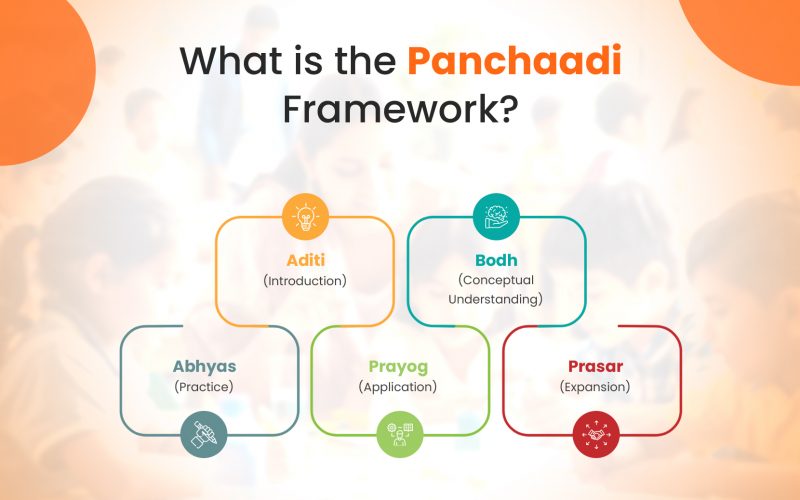
Panchaadi is a five-step learning process described in the NCF. It supports competency-based education, enquiry, practice, and application. These steps help teachers design Panchaadi lesson plans that build understanding slowly and clearly. The five steps are:
Aditi, Bodh, Abhyas, Prayog, and Prasar.
These steps fit well with NCF-SE and NCF-FS expectations, especially for early years and school education.
What are the 5 Steps of the Panchaadi Approach
- Aditi (Introduction)
The teacher plans the lesson by connecting the new topic with something the students already know. This is the first step, Aditi or introduction. Students observe, question, and explore. - Bodh (Conceptual Understanding)
In the next step, student understand the core concept through guided play, enquiry, reading or any other method that the teacher deems appropriate. This is the second step, Bodh or conceptual understanding. - Abhyas (Practice)
To further understand, the teacher helps the learners practice through activities such as group work, short tasks, worksheets, or hands-on work. Abhyas or practice helps build confidence and strengthens skills. - Prayog (Application)
After abhyas, the students try to connect it to the real world situations. This is done through project work, a daily-life task, or an activity. This is Prayog or application. - Prasar (Expansion)
In the last step, students share what they have learnt. They speak with peers, retell ideas, read together, sing, or create new examples.
How to Implement the Panchaadi Framework in a Lesson Plan
Teachers can build an NCF lesson plan around Panchaadi by keeping the flow simple:
- Define learning outcomes
NCF has provided comprehensive guidelines and outlines for learning outcomes for each class and subject. Use NCF and NEP 2020 as the guiding point. - Place activities under each Panchaadi step
- Aditi: short prompt, picture, quick question
- Bodh: enquiry, reading, guided discussion
- Abhyas: practice tasks, pair work, small projects
- Prayog: apply concept in real life
- Prasar: share or create something new
- Check for competencies
Panchaadi framework supports competency-based progress. This ensures that students move from rote learning to being active participants in their learning journey. - Keep the plan easy to work with
Simple steps help teachers save time during class.
AASOKA’s Panchaadi-Aligned Lesson Plans
AASOKA builds its lesson plans on the Panchaadi approach. Each plan follows the five steps so teachers can conduct classes in a structured way. The plan remains the same across all subjects. The lesson includes different teaching pedagogies and activities. These activities are student-friendly and can be conducted by teachers across regions. This helps them focus on interacting more with the students rather than spending hours planning their lessons. Here is how the Panchaadi flow appears in AASOKA lesson plans:
- Aditi
Every chapter begins with a recall question in the form of a picture, a simple prompt, or a quick question to link the concept with what students already know. - Bodh
With the help of multimedia videos, discussions or small tasks, the concept is introduced to the learners. This helps build understanding in a slow and clear way. - Abhyas
AASOKA adds practice activities that match the competencies listed in the NCF. Teachers can use worksheets, group tasks, or short exercises to strengthen the concept. - Prayog
Application tasks help students use the concept in real life. This may be a small project, an observation task, or an everyday example linked with the topic. - Prasar
Each lesson ends with sharing. Students may retell, discuss, read together, or create something simple.
Since AASOKA follows this Panchaadi sequence, teachers do not have to redesign the lesson flow. They can open any AASOKA NCF-aligned lesson plan, check each step, and use it directly in class. This saves time and keeps teaching consistent with NCF 2023, NEP 2020, and competency-based education.
FAQs about Panchaadi Framework
- What is the Panchaadi approach in NCF 2023?
Panchaadi is a five-step teaching method as given in NCF. It uses Aditi, Bodh, Abhyas, Prayog, and Prasar to move from introducing a topic to expanding it. - How does Panchaadi support NEP 2020 and competency-based education?
Panchaadi encourages enquiry, practice, and real-life use of concepts. This matches NEP 2020 and helps teachers build competency-based classroom routines. - How can teachers use Panchaadi while designing lesson plans?
Teachers can use simple activities for Aditi for the opening, Bodh for concept-building, Abhyas for practice, Prayog for application, and Prasar for sharing. This keeps the lesson plan organised and easy to follow for the teachers as well as students. - How are AASOKA lesson plans based on Panchaadi?
AASOKA uses all five Panchaadi steps in every lesson plan. Each plan begins with Aditi, builds the concept in Bodh, adds practice in Abhyas, brings in application during Prayog, and ends with sharing in Prasar. - How do AASOKA lesson plans help teachers?
They save planning time because the Panchaadi steps are already built in. Teachers can use them as ready-to-use lesson plans for their classes. - Can Panchaadi work in digital or blended classrooms?
Yes. The five-step flow fits digital lesson plans for teachers and works well in blended learning environments. The structure stays the same across formats.