

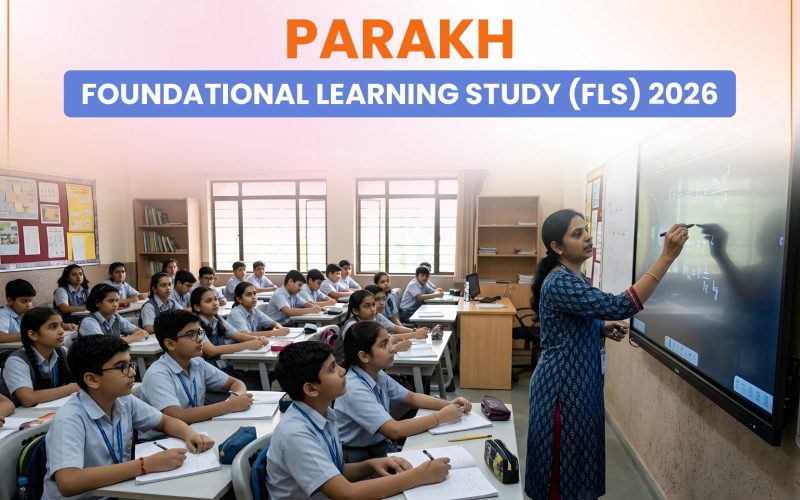
Basic reading, writing and mathematics are the foundation of a child’s academic journey. For children, it becomes important for them to develop these skills and become prepared to learn different subjects, think critically and build confidence. To promote these skills, NIPUN Bharat Mission was launched to attain universal foundational literacy and numeracy by 2026-27. Foundational literacy and numeracy refer to a child’s ability to read with meaning and solve basic maths problems by class 3. To assess the development of these skills nationwide, a study is being conducted called the Foundational Learning Study FLS 2026.
This study will be done by PARAKH. This will take place at the end of March 2026 and will assess the Foundational Literacy and Numeracy (FLN) competencies among students completing Grade 3. Inputs from this study will then further give an insight into what is working, what needs to be improved and the changes that need to be done in terms of policy and frameworks. This will also guide the implementation of new teaching pedagogies, and interventions to strengthen early learning.
What is the Foundational Learning Study 2026?
FLS is a nationwide assessment to evaluate whether students have developed the necessary basic literacy and numeracy skills as expected by the end of Grade 3. There will be two key areas that will be in focus for the study.
- Foundational Literacy: This includes basic reading, comprehension and language skills.
- Foundational Numeracy: This includes number sense, arithmetic understanding and problem-solving ability.
For students to grow up with strong foundational learning skills, they will have less difficulty in coping with different subjects as they move on to higher classes. With a weak base, they will have trouble understanding in later grades. This is the reason national education initiatives prioritise a strong emphasis on monitoring at the foundational stage. The assessment will be carried out by PARAKH (Performance Assessment, Review and Analysis of Knowledge for Holistic Development) under the guidance of NCERT.
Why is FLS 2026 important?
The Foundational Learning Study will help the Indian Government to understand the success of foundational learning programmes across the country. The evidence-based study will provide important insights for future planning. This assessment will help to:
- Identify learning gaps in reading and mathematics
- Support better planning for early grade education
- Design targeted learning interventions
Strengthen teaching practices in primary classes
What is changing in FLS 2026?
Although, the most striking change in the study this year is the shift from paper-based assessment to tablet based digital platform. This will greatly improve the quality and speed of the assessment process. This also shows that there is an increased use of digital tools in educational evaluation procedures and studies. Many of the advantages to be provided by this method include:
- Increased accuracy of data, as everything will be digital
- Analysis and release of reports would be faster
- Manual errors due to loss of files and handwriting errors would significantly reduce
Large-scale assessment would be conducted more efficiently.
What is the scale of the foundational learning study 2026?
The FLS will be conducted on a national level, i.e. across the country. According to CBSE,
- More than 10,000 schools will participate
- Over 1,00,000 students will be assessed
- The study will cover 776 districts
Participation will span 36 States and Union Territories
What role will the schools have in the study?
The selected schools will play a critical role in ensuring that the assessment process is conducted without any delays or issues. However, for this to happen, CBSE has requested the leaders of affiliated schools for the following:
- The schools should remain open and operational on the given assessment dates.
- Assessment teams visiting the school for study should be provided with full cooperation.
Administration of the assessment will be managed by the same teams and will require the support of the teachers.
How The Study Will Be Coordinated
FLS will involve collaboration between various educational institutions and government bodies. These institutions will ensure smooth implementation and is carried out At the national level. Technical guidance will be provided by PARAKH at NCERT. At the state and district levels, coordination will be handled by agencies including:
- Samagra Shiksha
- State Council of Educational Research and Training (SCERTs)
- State Institutes of Education (SIEs)
- District Institutes of Education and Training (DIETs)
District Education Offices
What will happen after the study is done?
Once the study is finished, the results will be analysed. These results will then provide valuable evidence for improving foundational education in the country. Furthermore clearer insights will be made available to the educators and policy makers to understand where additional support is needed, which strategies are working well and how different programs can be improved for teachers and students.
FAQs
Q. What is FLS 2026?
Ans. FLS stands for Foundational Learning Study 2026.
Q. Who will conduct FLS?
Ans. PARAKH will conduct this study across schools nationwide.