

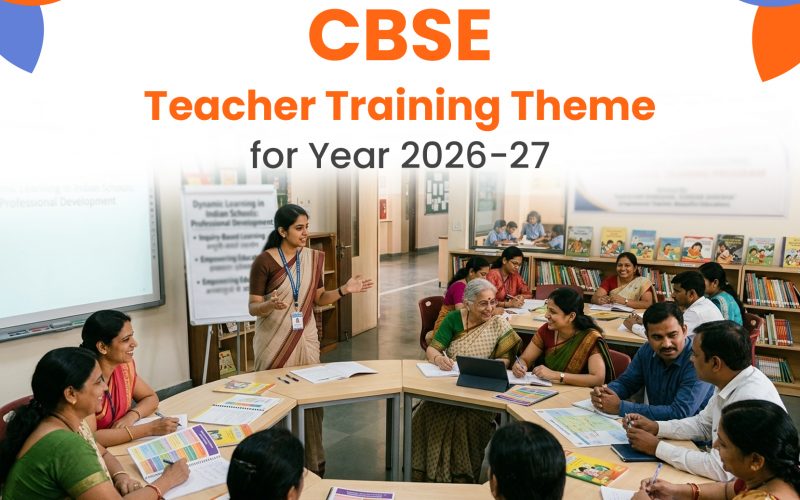
Summary: CBSE Teacher Training Theme 2026 has been decided. Computational Thinking (CT) and Artificial Intelligence (AI) will be the main theme, where district-level workshops, expert-led sessions and regional workshops will be the main source of providing training to teachers.
The Central Board of Secondary Education has announced its training theme for the 2026–27 session, and it’s pretty clear what the focus is this time Computational Thinking (CT) and Artificial Intelligence (AI). This comes straight from the direction set by the National Education Policy 2020 and the National Curriculum Framework for School Education 2023, where the push has been towards more practical, skill-based learning.
Along with this, CBSE is also bringing in a CT and AI curriculum for Classes 3 to 8. So this isn’t just a theme on paper. Schools will actually have to work around it through the year.
Why CT & AI are the CBSE Teacher Training Theme 2026?
At first, it might sound like schools now need to “teach AI”, which can feel like a lot. But that’s not really the point. This is less about adding a new subject and more about changing how things are taught. Computational Thinking is basically about helping students think step by step, break problems down, and look for patterns. If you think about it, teachers already do this in Maths, Science, and even in some language exercises. The idea now is to do it more consciously. AI, on the other hand, is being introduced in a very basic way. Students are not expected to learn coding or anything complex. It’s more about understanding what AI is, where it’s used, and why using it responsibly matters.
What does this change for teachers?
Teachers are expected to start bringing these ideas into their regular teaching. Not as a separate topic, but as part of how lessons are explained. So instead of just finishing a chapter, there’s a bit more focus on how students are thinking through it. CBSE has also listed the areas where training will focus. This includes the basics of CT and AI, using simple activities that slowly build into more abstract thinking, and connecting subjects instead of teaching everything in isolation. There’s also a strong push on showing how concepts apply in real life, and on talking about the ethical side of using AI. This is not about learning something completely new from scratch. It’s more about adjusting how lessons are already being handled.
How will the training happen?
CBSE has kept the structure clear. There are three main ways this will be done.
First are district-level workshops. These are one-day, offline sessions where schools come together, share ideas, and discuss what’s working. Some of the work done here may even move to a national level later.
Then there are expert-led sessions. These are shorter and more flexible, sometimes online, sometimes offline, depending on how schools organise them. These are more focused and usually led by someone with experience in the area.
The third is regional workshops run by CBSE through its Centres of Excellence. These are more formal, require registration, and count towards official training hours.
What is the role of schools?
Schools will need to figure out who is attending which training, whether they want to host something, and how they’re tracking participation. There’s also the basic work of maintaining records, since all of this ties into professional development hours. Beyond that, it really comes down to small changes. How lessons are planned, how activities are designed, and how students are encouraged to think. It doesn’t have to be a big shift all at once.
This isn’t about turning teachers into AI experts. What CBSE is really trying to do is push classrooms slightly in a different direction, less memorising, more thinking. It may feel like just another initiative right now, but over time, it’s likely to settle into regular teaching practice like most other changes do.
Nice
It’s really great initiative as well and amazing opportunity to all of us. Thanks
Notify regarding venue and date