

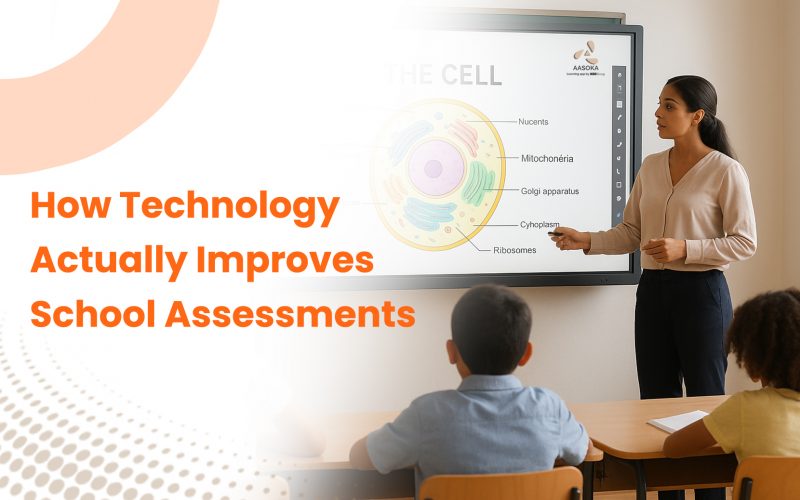
Schools today use many tools to check how well students understand a topic. This shift did not happen because technology looks modern. It happened because teachers needed support. Manual checking is slow. Test creation takes time. Reports often reach parents late. Technology in school assessments tries to solve these common problems in a simple way. AASOKA follows the same idea. Teachers handle a lot each day, and assessments take a major share of that work. With AASOKA, this load becomes easier to manage. And while technology cannot solve every issue in classrooms, it does help with clarity, speed, and accuracy. Here is how it works.
1. Test preparation becomes easier
Creating a good test takes effort. Teachers must choose the right difficulty, match the syllabus, and check alignment with Bloom’s Taxonomy. Technology makes this process quicker. On AASOKA, teachers can pick questions from a large question bank. They can filter by concept, type, or level.
This fits under edtech assessment, AI assessment, education, and digital assessment platform features used by many schools. It is not about making tests fancy. It is about giving teachers control without extra work.
Teachers can also choose between formative assessment and summative assessment styles. They can run small checks during lessons or conduct larger chapter tests. The process stays the same, and the platform keeps everything organised.
2. Checking answers becomes faster and more accurate
Objective questions such as MCQs or fill-in-the-blanks get checked instantly. This reduces manual errors and keeps the process fair. Teachers still review subjective answers themselves, which maintains human judgement where it matters.
This is one of the strongest uses of technology in school assessments. Automated checking does not replace teachers. It only reduces the repetitive parts of the job. And because students receive results quickly, they understand their mistakes sooner.
Platforms like AASOKA also create clean, simple reports. Teachers do not have to combine marks or prepare charts manually. The system compiles everything. This helps with faster decision-making and smoother communication with parents.
3. Better insights through data-driven evaluation
One major benefit of digital tools is the ability to see learning patterns. A single score does not tell much. But topic-wise breakdowns show exactly what a student knows and what they need to revise.
AASOKA offers learning gaps analysis. This shows which concepts need attention. For example, a class might be doing well in number systems but struggling with algebraic expressions. This helps teachers plan lessons with clarity instead of guessing. Schools also benefit from real-time student performance tracking in schools. Progress can be checked at any point in the year. These features support competency-based assessment, which aligns with NEP 2020 and current national guidelines.
4. Personal feedback supports student growth
Every student learns differently. When assessments are supported by technology, feedback becomes more personal. Students see corrections right away. They understand errors while the topic is still fresh.
AASOKA also offers personalized learning assessment through follow-up practice suggestions. If a student needs more work on a concept, the system shows related exercises or videos. This shifts the purpose of assessments. They do not stay limited to scoring. They turn into a part of daily learning.
Adaptive testing is another tool. Here, the difficulty of questions changes based on the student’s responses. This helps teachers see the true level of understanding. Adaptive testing is now a common part of technology in school assessments in many schools.
5. Clear reports build trust
Simple, transparent reporting matters. AASOKA produces reports that show topic-wise progress, attempts, and growth. Teachers use these during PTMs. Parents understand them without long explanations. The reports stay objective because they come directly from the assessment data. This builds trust between students, teachers, and parents.
Why the shift to technology in assessments matters
Schools are moving towards systems that offer clarity and fairness. AASOKA supports these goals. It helps teachers save effort, gives students clear feedback, and provides data that guides classroom planning. Technology in school assessments is not about replacing teachers. It is about helping them focus on learning rather than paperwork.
FAQ Section
How does technology improve primary school assessments?
Technology simplifies test creation, automates objective checking, and gives clear reports. It also helps teachers understand learning gaps early so they can adjust lessons in time.
What are the benefits of AI-driven assessments for K-12 students?
AI helps with quicker feedback, cleaner data, and targeted practice suggestions. It keeps assessments consistent and reduces basic errors in checking.
What are the benefits of automated grading for teachers?
Automated grading handles objective questions instantly. This reduces repetitive work and keeps results fair. Teachers still review long answers themselves.
How do schools use data-driven instruction with assessment analytics?
Teachers study topic-wise reports to understand which areas need revision. These insights help them plan lessons more accurately and support students who need help.