


Board exams bring with them anxiety to perform. Students practice over and over again with CBSE Sample papers, CBSE Additional Question Papers, model test papers, previous years’ papers etc. With the help of these, they get a better understanding of the exam pattern and marking scheme. Although helpful, it is the little because if which students lose marks. Even if the answer is correct, these tiny things ultimately lead to scoring lower marks. Learn about the mistakes in board exams that students often make and end up losing marks.
It is important to know how to not lose marks. As losing half a mark here and half a mark there might not sound big but the total marks lost catches up. Read below to find out the hidden ways to not lose those marks.
1. Answering MCQs
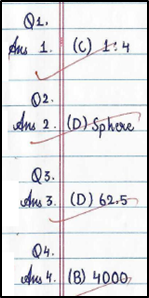
MCQs are a big part of CBSE Board exams 2026. Many students have the habit of writing the answer as ‘Q1. A, Q2.B’ and so on. The correct way to write the response is the following format:
The Correct Format: Question number + correct option (a, b, c, or d) + the complete option
Example: Answer 4: (c) It turns grey due to formation of silver metal
2. Subjective Answers (Answers that require proof)
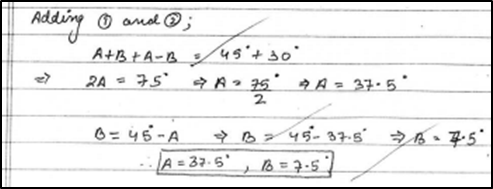
For many students, answering the question is limited to writing the formula and writing a few steps followed by correct answers. However, this is where most students lose marks as they hurriedly try to answer such questions. Solving the equation or the sum is not the only part but writing the formula, showing all the steps is as crucial. Each of these things carry marks. The correct way to answer such a question is given as follows:
Ans. 2:
Given: List the values provided in the question.
To Find/Prove: State the objective.
Formula: Place the formula in a box or underline it.
Calculation: Show every logical step without skipping.
Final Answer: Clearly state the units and box the final result.
This will ensure that formula, steps and the final answer are clearly visible. It would be easy for the examiner to allocated exact marks to the answer without skipping out anything. So, even if you have answered incorrectly, writing the steps and giving the correct formula will still get you some marks.
3. Diagrams – Construction
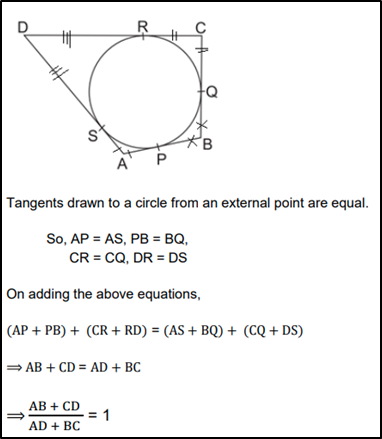
Diagrams are an important part of the exams. Simply practicing drawing it or construction it (Geometry) is not enough. It is important that you label it properly and write what you have drawn/constructed below it.
4. Diagrams, Maps and more
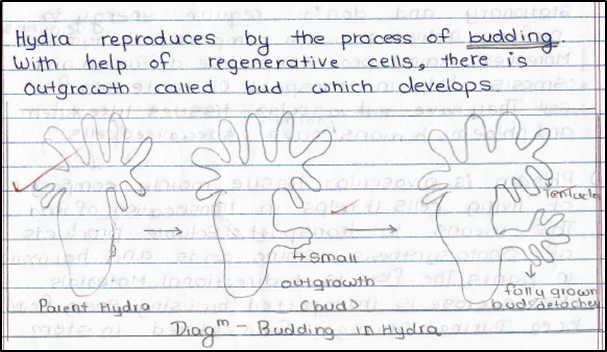
Diagrams are a part where you can score full marks really easily. Not writing what the diagram is about or a few details might make you lose marks. Always draw with a pencil and label it properly in neat writing. The same rule applies to maps and graphs.
5. Correcting Mistakes
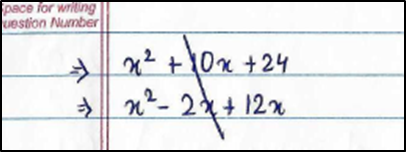
In subjects like Maths or physics, it so happens that while you are solving a problem, you realise that you used the wrong formula or made a calculation mistake midway. Instead of scribbling it out, cross it out with only one or two lines. Refrain from scribbling all over it.
Additional tip – If you don’t know the answer to a problem, try to at least write the formula.
These are some of the ways that will ensure that you do not lose out on marks, even 1/2 a mark is important. Keep these tips in mind to avoid making mistakes in board exams.
Key Takeaways
Read to not make these mistakes in board exams to score perfect marks.
- In MCQs, write the question number, option letter, and the complete option, not just A, B, C, or D.
- In numericals, always write the formula, show all steps, and clearly mark the final answer to secure marks.
- Diagrams must be neatly drawn, correctly labelled, and briefly described to earn full marks.
- Diagrams, maps, and graphs must be neatly drawn in pencil, correctly labelled, and briefly described to earn full marks.
- Cross out mistakes with one or two lines instead of scribbling to keep your work neat.