

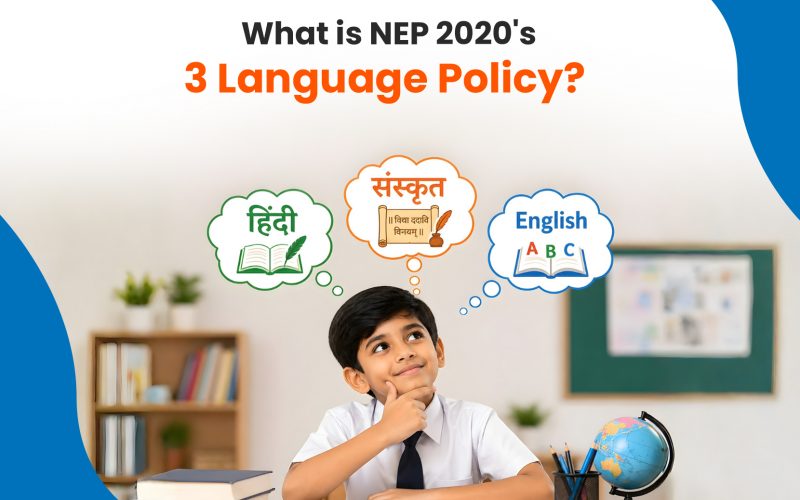
Ever since the National Education Policy 2020 came out, the 3-language policy has been one of the most talked-about parts. And also one of the most misunderstood. Some people think it makes Hindi compulsory. Others think students suddenly have more subjects. Neither is fully true. The confusion mostly comes from the way it’s discussed. So let’s just look at what it actually says, without overcomplicating it.
What is the NEP 2020 3 language policy?
The policy says students should learn three languages during their school years. Out of these three, at least two should be Indian languages. These could be Hindi, Tamil, Bengali, Marathi, or any other Indian language offered by the school. This isn’t something completely new. Schools in many parts of India already follow a version of this. NEP is just reinforcing it and trying to make it more consistent.
Is any language compulsory under NEP 3 language policy?
This is where most of the confusion sits. The policy clearly says that no language will be imposed. That means students are not being forced to learn Hindi or any specific language. What students study depends on the state, the school, and what options are available there. For example, a student in a Hindi-speaking state might study Hindi, English and another Indian language. In a non-Hindi-speaking state, it could be the regional language, English and one more Indian language. So the idea is flexibility, not a fixed rule for everyone.
Need for studying these languages
Language is always a sensitive topic in India. Any time there’s a policy that even sounds like it might push one language over another, it gets attention. That’s what happened here, too. In reality, the policy is trying to do the opposite. It’s trying to make sure Indian languages don’t slowly disappear from classrooms where only English or foreign languages are being prioritised.
How is this different from CBSE rules?
This is where things get mixed up. NEP is just a broad policy. It gives direction, but it doesn’t tell schools exactly how to implement everything. Boards like Central Board of Secondary Education take that direction and turn it into actual rules. That’s where terms like R1, R2 and R3 come in. So if you’ve heard specific rules about exams or language structure, those are usually from boards, not directly from NEP.
Why push for three languages at all?
This part is actually quite practical. Most students in India already grow up hearing or speaking more than one language. The policy is just building on that. There’s also enough evidence to show that learning multiple languages helps with memory, understanding, and even problem-solving. But honestly, even without the research, it’s useful in day-to-day life. Being able to switch between languages is just normal in India.
What does this mean for schools?
For schools, this isn’t a one-size-fits-all situation. So implementation will look different everywhere. A school in Delhi won’t approach this the same way as one in Kerala or Tamil Nadu. They have to figure out:
- What languages they can realistically offer
- Whether they have teachers for those languages
What works for their students
Role of parents
Not much, to be honest. This isn’t something where you need to panic or make quick decisions. The policy sounds big, but at the ground level, changes will be gradual. What you can do is:
- Check what language options your child’s school has
- Understand how long those languages will continue
- Make sure your child is comfortable with the choices
What it means for students
It might feel like “one more thing to study”, but it usually doesn’t turn out that way. If anything, it’s more about exposure than pressure. Most students get used to it pretty quickly, especially if the teaching is decent. And later on, knowing more than one language actually helps, whether it’s in college, work, or just everyday situations. The NEP 3-language policy sounds like a big shift, but it’s really not as drastic as it’s made out to be. Students are expected to learn three languages, with at least two being Indian languages. Beyond that, there’s a lot of flexibility. Once you take out the noise around it, the idea is fairly simple.
FAQs on NEP 3-Language Policy
1. What is the NEP 3-language policy?
It means students are expected to learn three languages during school, with at least two being Indian languages. Schools and states decide the exact combination.
2. Is Hindi compulsory under NEP?
No. The policy clearly says no language will be imposed.
3. Is this a new rule?
Not really. Versions of the 3-language system have existed for years. NEP just reinforces it.
4. Who decides which languages are taught?
States, school boards, and individual schools decide this based on their context.
5. Can students still learn foreign languages?
Yes, but they are usually in addition to Indian languages, not a replacement for them.
6. Will this increase academic pressure? In most cases, no. It depends on how schools implement it, but the intent is not to add pressure.